The Baroque refers not to an essence but rather to an operative function, to a trait. It endlessly twists and turns its folds, pushing them to infinity, fold over fold, one upon the other. The Baroque fold unfurls all the way to infinity.- Gilles Deleuze, 199Rather than a continuing series of folds, differentials and modulations comprising the world as a folding, the baroque is actualized as a smoothing out of creases through accord, harmonization and the reintegration of fragments.- Anna Munster, 2006
The baroque

Lexicon of skin and decay
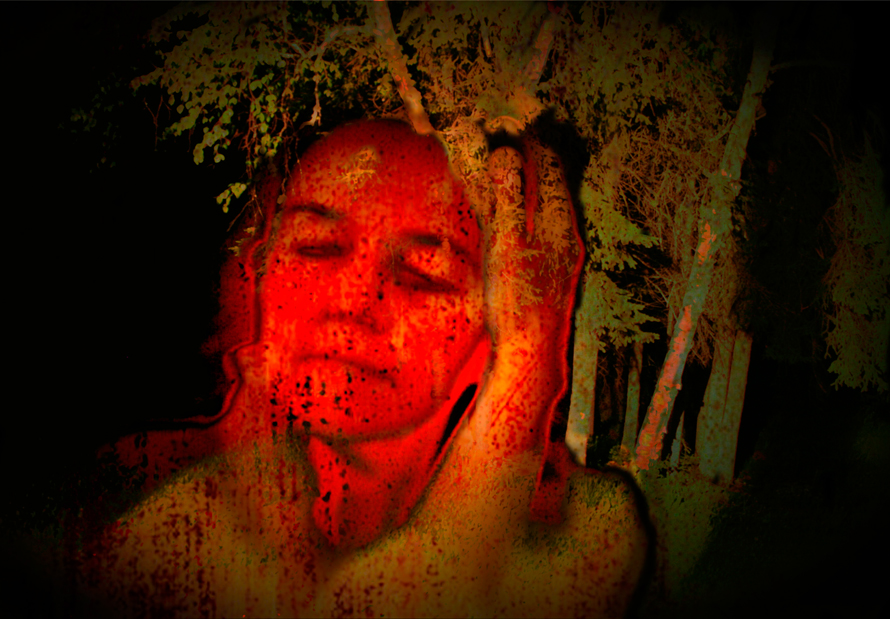
Skins or layers show transparencies and porosities, as well as change and transformation. Decay can also take on many of these characteristics—especially when associated with aging.
Here are the beginnings of a lexicon of skins, change and decay that can be used to help describe what my photo composites might evoke:
blistered wrinkled pleated fringed feathered decayed peeled ravaged distressed decomposed degenerated destroyed deteriorated dying changed renewed reborn transformed surfacing skin pellicle flesh encounters interrelated intertwined co-responsive intercalated folds layers crossovers interminglings (in)visible transparencies translucency superimposed porosities veils strata resonance (inter)connectedness liminality intercorporeity
Uchiwa fan

Encaustic

In the Buddha piece above, rubbing, scratching, scoring, stamping and other techniques were used to enhance the initial image printed with pigment ink on unryu washi paper which was mounted on thin plywood. This is the kind of work I am aiming for since it allows me to get my hands dirty again and create a unique work.
Mobileography exhibition at the PhotoHaus Gallery

Five photos taken with my iPhone or iPad were selected for the show.


manikins
 |
| Towards Terra Verde |
I've been working on a "manikins" series of photographs since Andro moved in. I was interested in trying out image projections as well as superimposition of images onto the body. The theme for the series is that these entities abandon their current planet of habitation (whether forced to because of some cataclysm or by personal choice) and migrate to another world that will hopefully be better... some nirvana. During the voyage, they come across new worlds, experiencing feelings of nostalgia and anticipation. New vistas are projected onto their bodies — they are but an expression of the external.
This exploration also brings up interesting questions about the make gaze, since the manikins evoke a certain degree of sensuality. Does the theory of the male gaze (the photographer's) apply to an object (the manikin)? Can an object be subjectified — in this case, is the object assuming traits similar to those of a human? Interesting... Isn't it spelled "mannequin"? Well, it seems that "manikin" is an accepted alternative spelling, which I have adopted for this series.
You may also be interested in searching the Web for Eugène Atget and Lee Friedlander, two photographers who have taken photographs of mannequins in shop window displays. Also, an introductory video to Season 5 of Mad Men, "What Is There to Love If Not the Enigma?" provides insight into the life and artwork of metaphysical artist Giorgio de Chiricho who expressed his own interested in the mannequin.




Subscribe to:
Posts (Atom)