wood nymph folio book set


wood nymph is about an artist and a wood nymph. It evokes struggle, transformation and rebirth through a deep longing for change, tempered by a strong determination to preserve an existing order. It illustrates a bond between nature and human.

The folio book set comprises handmade components that engage the reader in quietly discovering the spirit of the woodland through sight and touch.

All components are enclosed in a 5" x 5" x 1” paper case with four folding flaps and a sliding belly band.


A four-page colophon, assembled flutter book style (Japanese sempuyo), contains the artist's preface and details on the paper, printing, editioning and copyright.


A second flutter booklet features a freestyle twenty-two-page poem; a handmade caddisfly larva case, constructed of leaf, twig and other materials, serves as a bookmark.


The reader can display and view on a small easel stand a series of nine photographic archival pigment ink prints on paper, assembled in a folder. In addition, a translucent beeswax-infused photographic print on Japanese unryu washi paper waits to capture ambient light.


Sample pages:

Colophon, pp 1-2
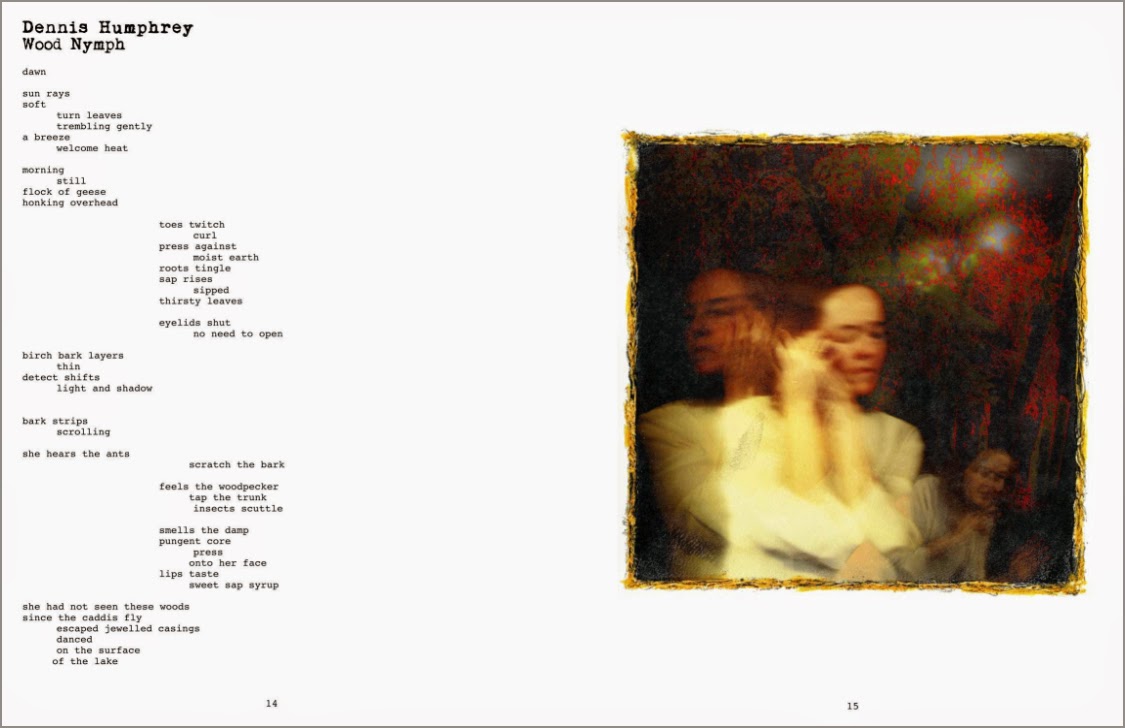
Poem, pp 6-7


This is an open edition; each set is signed and numbered by the artist.


The book and photo print as experiential objects

I've just completed a handmade folio edition of wood nymph.

I'm interested in the physicality of books and photographs and in moving them off the wall, shelf and screen into one's hands.

For me, the handcrafted artist book is a 'living' object, offered by the artist-writer to the reader in order to be felt, touched and viewed. It can be an experience whereby one discovers new layers of meaning while engaging physically with the content, the format and the components.

The same applies to a photographic print, often trapped behind a mat and glass, contained within a frame and nailed to a wall—out of reach of the viewer. I have explored various ways of making my photographic prints more tactile and visual, by printing on Japanese washi paper, infusing them with wax, or creating mixed media encaustic images. These translucent pieces capture light and can be viewed suspended, hung away from the wall. They can be touched since they are not confined to frames or trapped behind glass. The pieces can also move with air currents and change as the ambient light does.

The issue, however, especially if one is not really into gallery showings, is what to do with the inventory of prints one produces, other than give them away to friends?

For me, one answer is to create small photographic prints (e.g., 5" x 5"), with or without encaustic. These less expensive images can be part of an artist's book, shared with and touched by friends and colleagues (e.g., ATC style). One can provide a small simple easel to display these miniature pieces.

My recent wood nymph folio case is one example of such a multi sensory experiential piece.


Mushi no Hoshi - Space Insect

Felt very privileged on March 21 to attend Darakudakan's butoh performance of Mushi no Hoshi with J at the Vancouver Playhouse. It was very dramatic and professionally presented. This was their only stop in North America. Even in Tokyo, where they live and work, it's difficult to take in one of their shows since they are few and far between.

The title, Mushi no hoshi, was translated as "Space Insects",  but I've seen it translated for their Paris performance as "Planet of Insects," which may be more accurate. The 30-year-old dance troupe gave it their all, with no intermission and several encores spurred on by a very enthusiastic crowd.

...With 22 surreal, shape-shifting dancers, other-worldly costumes and body-paint, and a spectacular set, Dairakudakan exemplifies the transformative power of butoh through its imaginative blend of theatre and dance. Mushi no Hoshi – Space Insect was choreographed by artistic director, Akaji Maro... ~ Vancouver International Dance Festival


Poster featuring Akaji Maro

More photos from their 2014 performance at La Maison de la culture du Japon in Paris.


Adore Noir & Adore Chroma magazines


Cover images © Adore Noir & Adore Chroma respectively

Adore Noir and Adore Chroma are (PDF) fine art photography magazines published in Vancouver, Canada.

Adore Noir celebrates works in black and white photography (23 issues to date), whereas the recently introduced Adore Chroma (4 issues to date) focuses on fine art colour photography. Each issue features several international artist portfolios (each including photos and an interview), as well as articles on various subjects of interest to the fine art community.

Adore Noir: http://www.adorenoir.com
Adore Chroma: http://www.adorechroma.com

Great reads, with an interesting diversity of artists and short articles. The subscription price to each is very affordable.

Lauren E. Simonutti's books

Lauren E. Simonutti was a gifted and prolific American fine art photographer. She passed away in 2012 at the age of 44. The sensitive and soft harshness of her images echoed her constant turmoils in the face of mental illness. She lived the latter part of her life inside her old house, capturing images that recorded her inner self. She had a very active presence online on deviantART, flickr and blogger, among others.

Two books on her art are available on blurb:
"Over three and one half years I have spent alone amidst these 8 rooms, 7 mirrors, 6 clocks, 2 minds and 199 panes of glass. And this is what I saw here. This is what I learned." ~ Lauren E. Simonutti

LAUREN E. SIMONUTTI: 8 rooms, 7 mirrors, 6 clocks, 2 minds & 199 panes of glass, c2011
Catherine Edelman Gallery
Cover image: She Left a Light on but They Were Never Coming Back  © 2007 Lauren E. Simonutti

The Devil's Alphabet, 2011
Lauren E. Simonutti
Cover image © Lauren E. Simonutti

You can read an earlier interview with Lauren Simonutti by Susan Burnstine on her blog, underexposed:

http://blog.susanburnstine.com/post/21902234398

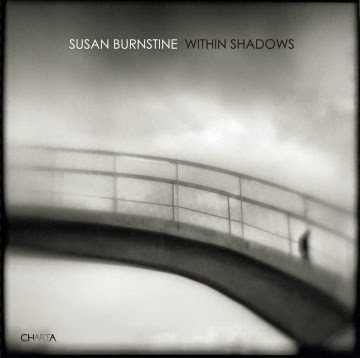
Susan Burnstine's 'Within Shadows'

Image © Susan Burnstine

Susan Burnstine is a contemporary American fine art photographer. Her personal style of black and white photography echoes qualities of the late 19th/early 20th century Pictorialist movement. Through ethereal, out-of-focus images, Susan represents moods and elements of her dreams with cameras she built from salvaged lenses and other camera parts.

Her 2011 hardcover book, Within Shadows, contains 100 pages with 45 duotones, accompanied with text written by George Slade, Russell Joslin, Susan Burnstine and Susan Spiritus.

Find more information on her website: http://www.susanburnstine.com/books.htm

You can read an interesting interview with Susan by Jonathan Burnstine on aPhotoEditor:

http://www.aphotoeditor.com/2014/06/11/susan-burnstine-interview/

Eyemazing Editions 2014 Annual Pictorial


The Eyemazing Editions' 2014 Annual Pictorial is out. Edited and published in The Netherlands by Eyemazing Susan (Susan Zadeh), this is a large format hardcover book, filled with fascinating contemporary fine art photography by 42 international artists.

Check out the EYEMAZING EDITIONS website: http://eyemazingeditions.com

Echoes of Bluemars

For years, I listened to the Bluemars ambient music streams on the Internet, at night before or during sleep, or while writing or working in the studio. There were three separate streams: Bluemars (Music for the Space Traveller), Cryosleep (Zero Beat Guaranteed) and Voices from Within (Words From Beyond). Cryosleep especially provided the ambience for me to enter into a non-intrusive other-worldly realm where my mind seemed to float, suspended, as I savoured the lightness and textures of the sonic pulses.

On and off over the years, Bluemars suddenly stopped transmitting in 2013. However, in late 2013, overrider created Echoes of Bluemars; as curator, he has made certain that the revived fleet of streams remains faithful to its origins.
"In attempts to reestablish communication with the lost Bluemars fleet, an echo of past transmissions was found. Retransmitting signals from years ago, these echoes give us a glimpse into the past."
http://echoesofbluemars.org

The streams are definitely worth exploring.

There is also an Echoes of Bluemars Facebook page, if you're interested.

Enjoy!

Latent Image magazine

Five full pages, including an excerpt from my wood nymph poem and several images, were published in Issue No. 4 (Fall 2014) of Latent Image, an online magazine edited/published by Allison White and Nicole Langdon-Davies from Vancouver.

Their 'zine is "a story of images and words, juxtaposed." The online digital version is free to view; you can also purchase a hardcopy version.


2 of 5 full pages


Art shows in Japan

While in Tokyo, I visited the Hokusai exhibition at the Ueno Royal Museum close to where we were staying. It was great to see Hokusai's ukiyo-e masterpieces up close.


We travelled to Mount Fuji where we visited the Itchiku Kubota Art Museum. Many years ago, I had bought an oversized book (Opulence) that showed the wonderful kimono created by Itchiku Kubota. He had succeeded in reviving the long-lost technique of tsujigahana. If you're interested in seeing more about the Kubota kimono, go here.


Trip to Japan

J & I recently travelled to Japan, visiting Narita, Tokyo and Mount Fuji. It was a great trip! It's always inspiring to visit a country that has such a sense of aesthetics and design.

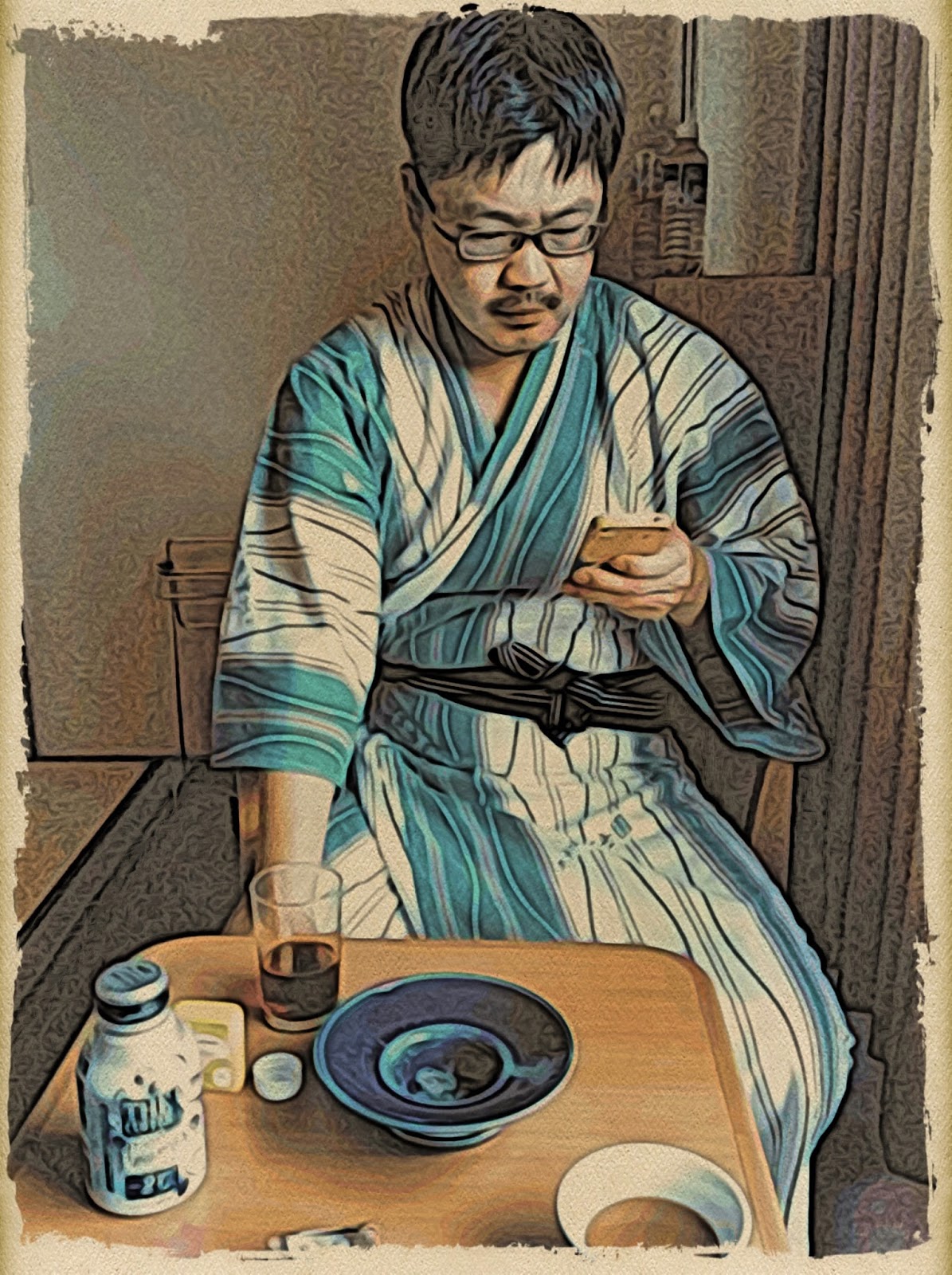
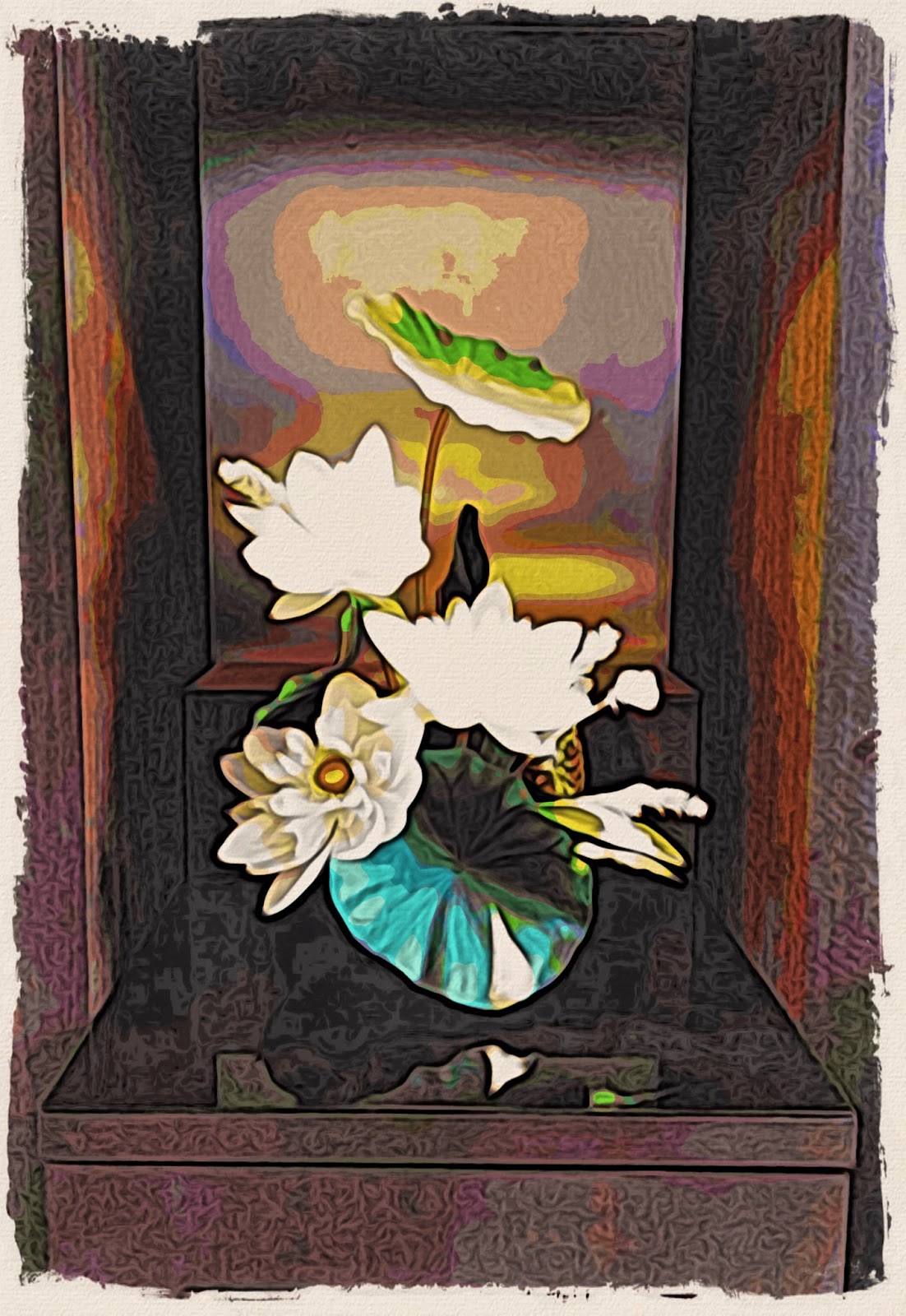
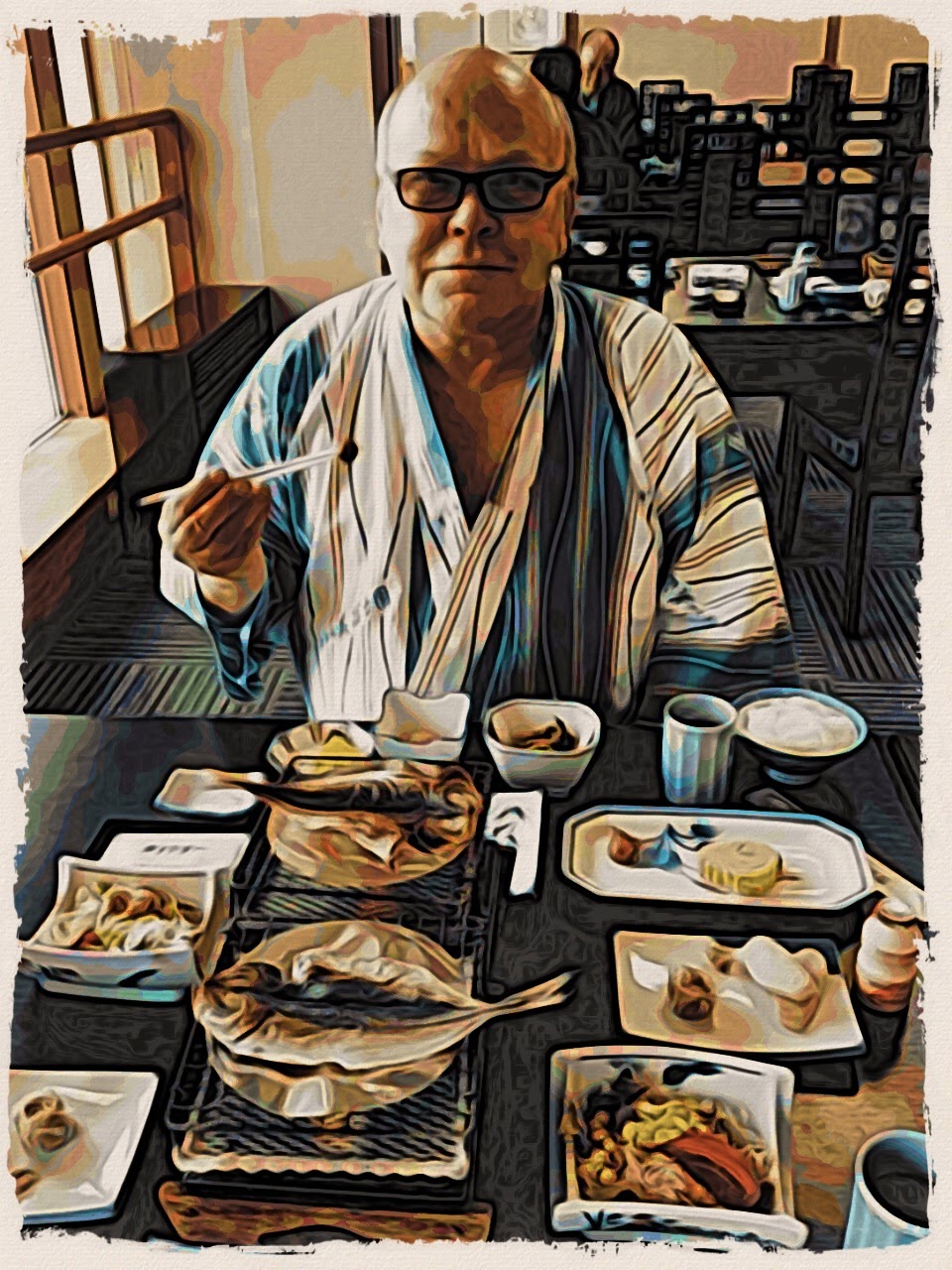
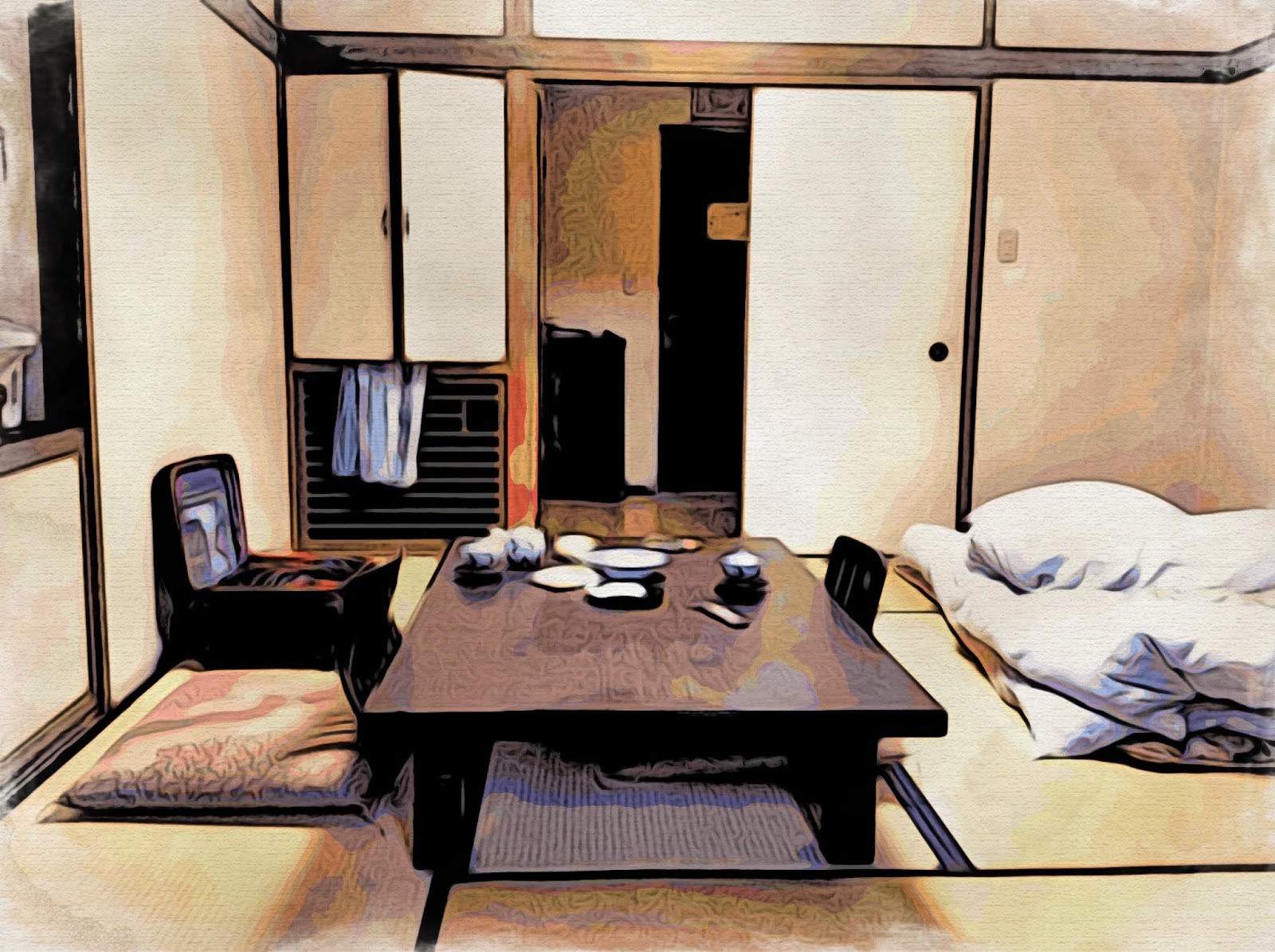
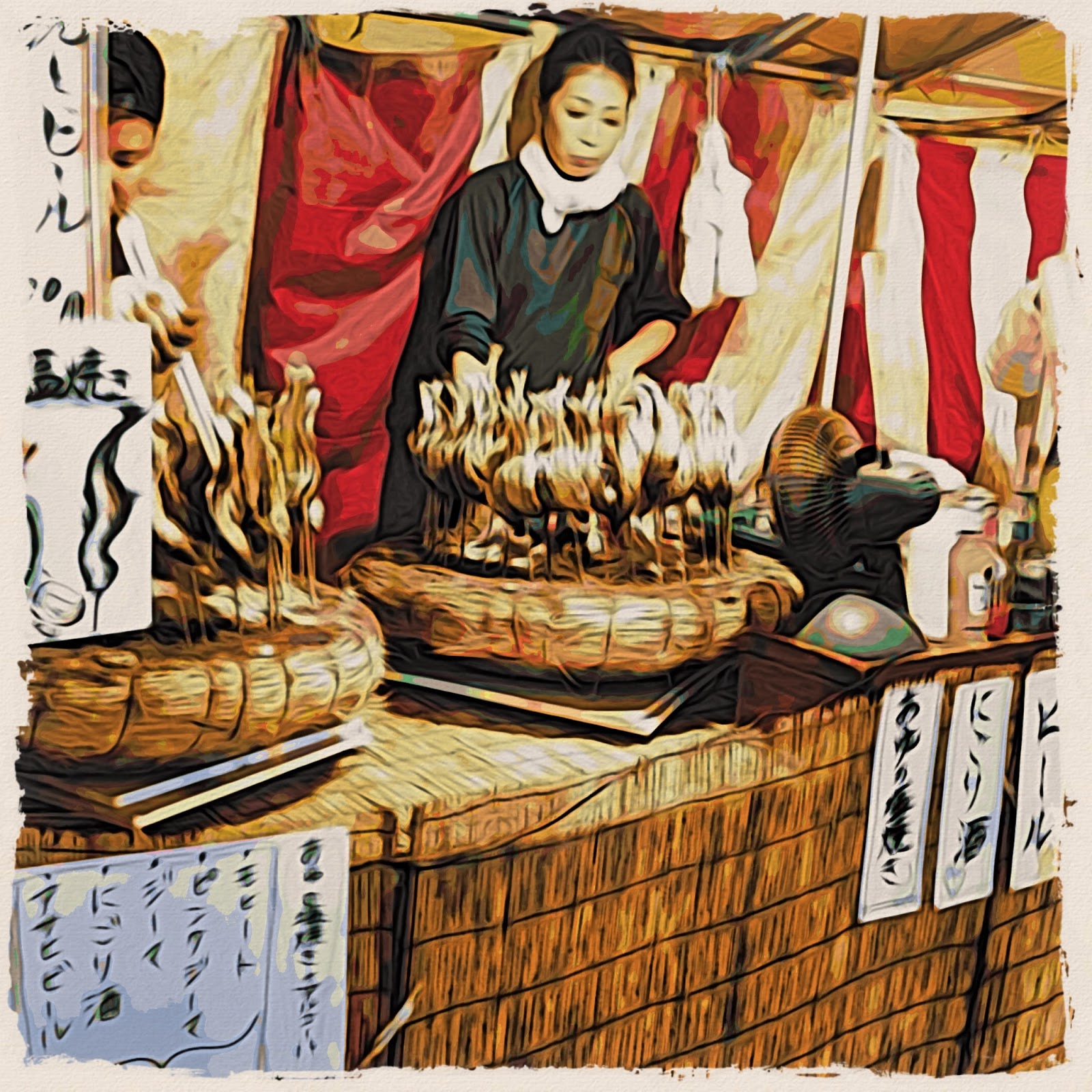
If you're interested in viewing an online slideshow of the trip, please hop over. Here are a few images from the trip... (I used an iOS app called Moku Hanga (woodblock print) to postprocess the photos.

Garden at Itchiku Kubota Museum

J in our Japanese-style room

Lotus ikebana in hotel lobby

J in the museum garden

Enjoying a Japanese-style breakfast
Japanese-style room

Food stalls at Tori-no-Itchi festival in Shijuku, Tokyo

wood nymph frontispiece


If you have purchased a hard cover copy of wood nymph, please send me an email to let me know the details (order date, name, address). I'll send you a copy of the frontispiece. Send to:

d e n n i s h u m [at] g m a i l [dot] c o m

New book: wood nymph

I recently finished wood nymph, my new book on blurb. It's an homage to Mary, my artist friend, muse and mentor. The book consists of a freestyle poem augmented by numerous photos transformed through various mediums: digital composite photographs, alcohol gel transfers on paper, beeswax and mixed media works on Japanese washi paper or wood panels.


This gives you an idea of the book's layout:


Mary posed for a photo shoot with me several years ago. This book is my interpretation, through images and words, of a wood nymph inhabiting a birch tree in the northern boreal forest, evokes struggle, transformation and rebirth through a deep longing for change, tempered by a strong determination to preserve an existing order. Though you cannot see her, the nymph still inhabits those woods, watching over us, smiling with amusement.

The 38-page book is available in 7" x 7" colour softcover and hardcover imagewrap formats.

To view a Preview of the book, click on the icon below.

wood nymph
wood nymph
by desean
Photo book

Enjoy!

Another backlit prototype

My initial experiments with waxed papers infused with wax over a heating plate, then sandwiched between two glass panes, have not been fully success flu. First, the front and back surfaces of the wax infused pieces on paper are in direct contact with the glass panels. If the piece is flat and has no texture, this might be fine, but, following the workshop in Victoria, I am again more drawn to altering the surface with texture: dripping, scraping, sctayching the wax applied with a hake paint brush, embedding leaves, drawing on it, applying fabric textures, rubbing diluted oil and spirit washes in the crevices, etc. This means the piece will have texture.

However, I do not tend to want to mount the pieces on a substrate. I seem to prefer exploiting the translucent quality of the wax infused washi paper, backlighting the pice using ambient light from nearby lamps and windows. This allows the piece to change as the natural and artificial light changes,  showing the front and the back.

In the test piece below, I have mounted the piece between the glass panes in such a way that the textures front is separated from the glass pane; only the back of the piece lightly touches the back panel. In this example, the light from the back plays with the wax droplets—an effect you wouldn't notice if the piece was mounted in a frame with a mat or mounted to a substrate. Note how vivid the colours are when the piece is displayed in this fashion, compared to the image in the previous post.


Advanced Encaustics workshop in Victoria

Earlier this week, I attended a 2-day Advanced encaustics workshop in Victoria led by Leah Macdonald. It was a nice follow-up to last year's Introduction to encaustics workshop. We worked with different types of papers (thin Japanese paper to thicker, more textured papers). Of course, I preferred the Japanese paper because of its thinness and translucency once infused with wax.

Wood Nymph, pigment ink & pencil on Fabriano cold press,
infused with yellow beeswax, oil paint, leaves 9.5 x 13 in, 2014


Untitled, pigment ink on Asuka washi,
infused with yellow beeswax, handmade paper, oil paint10 x 14.5 in, 2014

We also did one piece on a wood substrate.

Alien Contact, pigment ink, Kozo washi & Hahnemuhle Rag on wood panel,
infused with beeswax, oil paint, leaf, 10 x 14 x ½ in, 2014
We also explored making a simple waxed book using discarded and test prints, fabrics, thread, etc.

Suminagashi

I recently purchased a very practical and inspiring book on suminagashi (floating/spilled ink), the ancient Japanese art of marbling by dropping Chinese/India ink on the surface of water, then transferring the pattern to paper. Unlike the Western techniques of marbling, the process is very simple and does not require an additive to thicken the water, nor a dispersant to make the ink separate and expand. The 80-page book, containing 64 illustrations (38 in colour), was written by Anne Chambers, with a Foreword by Akira Kurosaki.

Suminagashi: The Japanese Art of Marbling: A Practical Guide
Anne Chambers, New York: Thames & Hudson, 1991

 Many years ago, I first explored suminagashi for use as a cover for a limited edition flutterbook of short freestyle poems entitled iro—colours. I have recently become interested once again, this time in order to create end papers for a limited edition flutterbook I am working on. It will feature a poem and archival inkjet prints about a forest nymph, printed on wax infused Japanese kozo paper.

Front cover of iro—colours by the author, 1987

Lyrical encaustic artists

While browsing encaustic artists' websites, I came across a few artists whose work resonated with me. The three artists below make use of Japanese washi or rice paper infused with wax, exploiting the paper's translucent qualities. Eisenberg and Guthridge both make use of photos printed with archival pigmented inks on Japanese paper, rendering semi-abstract segmented panels (Guthridge also superimposes panels)—like small windows of time for us to pause and look through. Roland first draws with coloured wax medium on a metal hotplate, then pulls monoprints from the wax layer.

All works evoke zen-like ethereal visual haiku poems, sometimes lit from behind, sometimes suspended away from the wall, fluttering, or mounted behind clear acrylic. The works seem to whisper to us softly in passing... inviting our eyes to touch....

Jeri Eisenberg

Sugar Maple Floaters (Orange), No. 6, 2008
Archival pigment ink on Kozo paper infused with encaustic, 36 x 34 in. Ed. 4/12, triptych
Source: http://www.markelfinearts.com

Jane Guthridge


The Space Between, Triptych - 4
Source: http://www.janeguthridge.com

Paula Roland


Connecting Dots
Encaustic monotype exhibition (backlit)
Source: http://http://www.paularoland.com

Backlit floating frame

Buddha 1, pigment ink on wax-infused kozo paper, ambient lighting, 10"x8"

I've experimented with floating frames where I can sandwich a wax-infused print between two pieces of glass. For the example shown above, I printed a photo on Awagami double-layered kozo, then peeled the kozo image layer from the pulp backing. The resulting image was then infused with encaustic medium on the hotplate. The paper is very thin (approximately 30 gsm) and enhances its translucency by capturing ambient light from the back. I prefer this method of backlighting to using LEDs since it is much simpler and the mood of the image changes constantly with the surrounding light.

Back view